

Chess Opening Principles: What Actually Matters in the Opening
Chess is a well balanced game. That is why so many different openings work, and why there are so many of them, each with countless variations underneath. Nobody has ever known all of it.
So what do you do when your opponent plays 1.b3 or 1.f4 or follows your main line for five moves and then leaves it on move six with something you have never seen?
How do you keep playing good moves once the moves you learned have run out?
That is what the chess opening principles are for. There are countless opening variations. There are five principles. Learning to apply those five properly will do more for your chess than learning any single opening line ever will.
The Trap of Learning Moves Without Ideas
You pick an opening. You learn the main line twelve moves deep. Then it works: your opponent cooperates, the moves go in, and you reach move twelve in a position that is objectively fine, maybe even slightly pleasant. And then you sit there with no idea what to do.
You do not know which pawn break you are aiming for. You do not know which of your pieces is the bad one. You do not know whether you want the queens on or off, or which endgame this structure is drifting toward. You knew the moves and you never learned the ideas behind them, so the moment the memorized part ends you are improvising from nothing, and you often throw away in few moves what the theory spent twelve moves building.
GM Reuben Fine called his classic book The Ideas Behind the Chess Openings, and the title is the whole lesson. The moves are the surface. The chess opening principles below are what generated those moves in the first place, which is why understanding them lets you keep playing sensibly long after the notation in your head runs out. Memorized lines do earn their place eventually, just far later than most players expect, and When Should You Start Learning Chess Openings? works through what is worth studying at each rating band.
1. Control the Center
Every list starts here, and it deserves the top spot.
Why the center matters
Put a knight on e4 and it attacks eight squares. Put the same knight on h3 and it attacks four, half of them behind it on your own side of the board. That arithmetic holds for every piece you own: the closer to the middle, the more of the board it touches. Centralized pieces also travel better. A bishop or knight in the center can reach either wing in a move or two, so whoever controls the middle can shift forces to wherever the fight breaks out faster than their opponent can respond.
There is a longer-term reason too. The pawn structure that forms in the center decides what kind of game you are playing: open and tactical, closed and maneuvering, or something in between. Whoever gets to set that structure gets to choose the type of position, which usually means choosing the type of position they are better at.
What "control" actually means
This is the part that gets misread. Control means the square is covered by your pieces and pawns more times than your opponent covers it, so they cannot use it. It does not mean you have to stand on it. A pawn on e4 does not control e4, it controls d5 and f5. A bishop on g2 controls d5 from the corner of the board.
The two ways to fight for the center
The classical approach is to take the center directly with pawns and back them up: 1.e4 or 1.d4, then support the center and develop around it. Simple, sound, and what most players should do most of the time.
The other approach is to let your opponent build the center and then attack it. The Grünfeld is the sharpest example: after 1.d4 Nf6 2.c4 g6 3.Nc3 d5 4.cxd5 Nxd5 5.e4 Nxc3 6.bxc3, White has a dream center on d4 and e4 and Black has almost nothing there. Black is delighted.
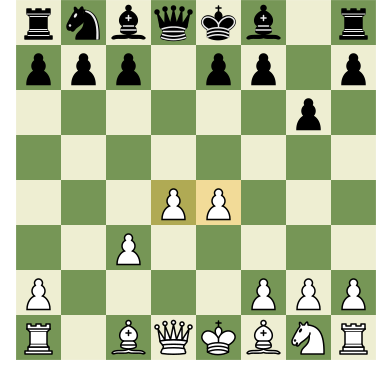
The bishop goes to g7 to fire down the long diagonal, then ...c5 hits the base of the center, and White's beautiful pawns turn out to be targets. The King's Indian does the same thing more slowly: Black allows the full center, finishes developing, and only then strikes with ...e5.
Both methods respect the principle. One says the center is worth owning, the other says it is worth attacking. Neither one ignores it, and that is the actual rule.
2. Develop Your Pieces Toward the Center
Why development matters
At move one you have eight pieces on the back rank and not one of them influences anything. Development is the process of converting that into an army, it takes twelve to sixteen moves to finish, and you only get one move at a time while somebody across the board is racing you.
The reason the race matters is that being developed first is what lets you open the position. Lines and files only favor the side with pieces ready to use them. This is why gambits work: give up a pawn, finish development three moves ahead, tear the position open, and your opponent's extra pawn is worth nothing because half their army is still at home.
Why toward the center
Same arithmetic as before, plus flexibility. A piece aimed at the middle keeps its options open, and in the opening you often do not yet know which side of the board will matter.
When it is right to develop slowly
This is the part the checklist versions never mention, and it matters.
Develop with a destination, not out of duty. A piece dropped on a square where a pawn can kick it next move has not been developed, it has been sent somewhere to lose a tempo. And sometimes the right square is genuinely unclear: in many Sicilians White's light-squared bishop can belong on e2, c4, b5 or g2 depending on what Black commits to, so waiting a move to see is not laziness, it is information.
Speed also matters far less in closed positions. When the center is locked and nothing can open quickly, there is time for slow regrouping, and the best square is worth more than the fastest route. The Closed Ruy Lopez has White routinely play Nb1-d2-f1-g3, three moves with one knight, to reach a square where it actually does something. In the Breyer Variation Black goes further and plays the extraordinary ...Nb8, retreating an already developed knight all the way home so it can come out again via d7. These look like beginner mistakes and they are top-level theory, because in that structure nobody can punish the time spent.
Finally, a quiet prophylactic move like h3 or a3, stopping a pin before it happens, is often worth more than another piece coming out.
And it is worth asking the same question about the opponent pieces, not only yours. A move that takes away the square your opponent's piece wants can do more than one that brings out your own. Bg5 pins the knight guarding d5. a4 stops ...b5 and develops nothing at all, and is sometimes still the best move on the board. Development is a means, not a score you are trying to run up.
3. Castle Early
Why castling early matters
A king in the center is fine right up until the moment it is catastrophic, and you do not get to choose that moment. Your opponent does. The center opens, files come through, and suddenly you are defending with pieces that never got out while their rooks are already pointing at you.
Castling also does something no other move does: it moves two pieces at once. The king gets behind a wall and a rook arrives near the center, for the price of one tempo. That is the best value in the opening, which is the real argument for doing it early rather than a vague appeal to safety.
When you can skip castling
When the center genuinely cannot open, a king in the middle is not in danger, and in some structures it is actively well placed. The Berlin Defence is the famous case: after 1.e4 e5 2.Nf3 Nc6 3.Bb5 Nf6 4.O-O Nxe4 5.d4 Nd6 6.Bxc6 dxc6 7.dxe5 Nf5 8.Qxd8+ Kxd8, Black has lost the right to castle entirely and it is a main line at world championship level.
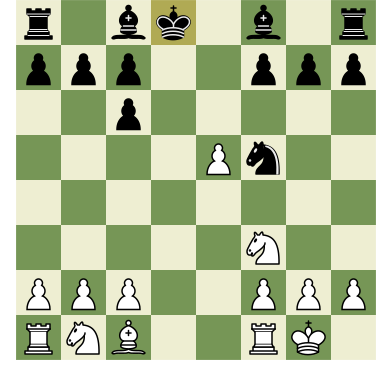
Queens are off, no attack is coming, and Black's king on d8 will walk to a useful square in its own time.
The general rule: with queens on and the center fluid, castle. With queens off or the center locked shut, the king is a piece rather than a liability, and you can spend those moves elsewhere.
Which side to castle
Kingside is faster and safer. Two pieces to move instead of three, and the king ends up on g1 behind three untouched pawns with no loose pawn on the edge. Queenside castling is a move slower and the king usually needs a further Kb1 to feel comfortable, but it puts a rook on d1 immediately, staring at the center. That is why attacking players like it.
Opposite-side castling changes the whole game
This is worth understanding properly, because it is where a lot of club players get slaughtered. If you castle kingside and your opponent castles queenside, the pawns in front of your king are no longer defensive furniture. They are ammunition. You can hurl your queenside pawns at their king without exposing your own, and they can do exactly the same to you.
The game becomes a race, and races have their own rules. Speed beats material, so sacrificing a pawn or a piece to open one file toward the enemy king is routine. Defensive moves that would be sensible in a quiet game are often just too slow. And the pawn moves in front of your own king, the ones that feel like making luft, now hand your opponent a hook to attack. The Yugoslav Attack against the Sicilian Dragon is the classic illustration: White castles queenside and throws h4-h5 forward while Black plays ...Rc8 and ...b5, and whoever arrives first usually wins outright.
So castling is not only about safety. It is a decision about what kind of game you want.
4. Do Not Move the Same Piece Twice
Why tempo matters
Every move is a unit of currency and you cannot get one back. Moving the same piece twice means you paid two moves for one working piece, and while you did that your opponent got two pieces out. Do it three or four times in an opening and you are effectively playing a piece down for the next ten moves, which is how people lose games without ever hanging anything.
When moving a piece twice is fine
Far more often than the rule suggests, and the exceptions follow a pattern worth learning.
Move a piece twice when the second move comes with a threat. A move that develops and attacks something is not a lost tempo, it is a gained one.
Move it twice when the destination is worth the trip. The Sveshnikov Sicilian runs 1.e4 c5 2.Nf3 Nc6 3.d4 cxd4 4.Nxd4 Nf6 5.Nc3 e5 6.Ndb5 d6 7.Bg5 a6 8.Na3, which is one knight moving four times and landing on a3, the ugliest square available.
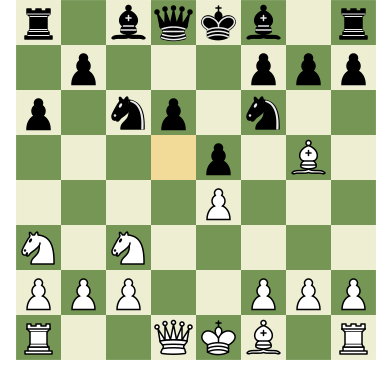
In some lines it continues to c2, e3 and d5 and moves three more times. It is not carelessness. The entire struggle in that structure is over the highlighted d5 square, and White will happily spend half the opening walking one knight there.
Move it twice when your opponent is paying too. In the Ruy Lopez the bishop goes b5, a4, b3 and often c2, which looks dreadful until you notice Black spent ...a6 and ...b5 doing the chasing, and those pawn moves are permanent while the bishop is perfectly happy on c2.
And move it freely when the position is closed. Here is the rule underneath the rule: tempo is expensive in open positions and cheap in closed ones. In a sharp open game a single wasted move can lose you the initiative and then the game. In a locked structure where nothing can be forced open for ten moves, you have time to put every piece on its best square, and the player who uses that time well comes out better. Almost every legitimate exception to this principle is really that distinction in disguise.
5. Do Not Bring Your Queen Out Early
Why an early queen backfires
The queen's problem is precisely that she is your best piece. Anything your opponent owns can attack her, and when it does, she has to move, because you are never trading a queen for a knight. So every attack on your early queen is a free developing move for your opponent.
Watch it happen in the Scandinavian: 1.e4 d5 2.exd5 Qxd5 3.Nc3.
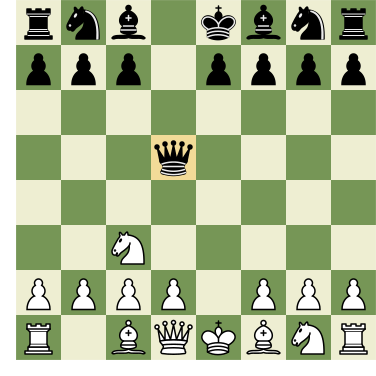
White develops a knight and hits the queen in the same move. Black moves her again, and White got a piece out for nothing.
The beginner version is worse. After 1.e4 e5 2.Qh5 Nc6 3.Bc4 g6 4.Qf3 Nf6, White has moved the queen twice, developed one piece, and Black has developed two while gaining time.
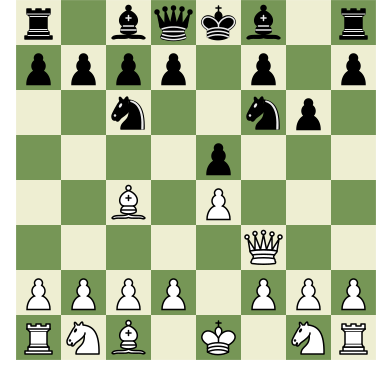
There is a second reason too. Early in the game the queen has very little useful to do. Central squares are contested by pawns and minor pieces, and she cannot sit anywhere near them. She becomes genuinely powerful once the position opens and there are targets on both wings, which is exactly when you want her available rather than already chased to some corner.
When the queen can come out early
When she cannot be harassed profitably, or when what she takes is worth the tempo. Black's ...Qb6 in many French and Sicilian positions is standard because it hits b2 and adds pressure to d4, and there is no comfortable way to kick her. The Scandinavian lines above are respectable theory precisely because Black judges the solid structure worth the tempo. And an early queen move that wins material is not an exception to anything, it is just good chess.
The test is simple. Before moving her, look at your opponent's pieces and ask which of them can attack her in the next two moves, and what they gain by doing so. If the answer is nothing, go ahead.
How to Open in Chess When You Are Out of Book
When your preparation runs out and you have to find a move on your own, run this loop. It takes about ten seconds.
- What did your opponent's last move do? What does it attack, what does it threaten next? Tactics outrank principles every time. No opening rule has ever told you to ignore a hanging piece.
- Nothing hanging? Look at the center. Can you claim a central square, or stop the opponent from claiming one? A pawn move that fights for the center is not a wasted move, it is the point of the whole exercise.
- Otherwise find the piece doing the least work. Getting a useless piece into the game beats slightly improving a busy one. Put it where it eyes the center and no pawn can cheaply chase it.
- Castle once you know which side you want, and think about what opposite castling would mean before you commit.
- Developed and castled? Now find the pawn break. This is where the opening ends and your actual plan begins.
This will not produce brilliancies. It will reliably produce a sound, playable position out of anything, including openings you have never seen and openings that are objectively bad, which is all you need from the first fifteen moves.
When to Break the Rules
Every principle above came with exceptions, and you will notice strong players living in those exceptions: queens out early, one knight dragged around four times, castling postponed indefinitely. In each case they have calculated something specific and concluded that here, in this exact position, the general rule does not apply.
Garry Kasparov put it better than anyone: "To become good at anything you have to know how to apply basic principles. To become great at it, you have to know when to violate those principles."
Note the order. Applying them comes first, and it is not the beginner stage you graduate out of. Principles are what you fall back on whenever concrete calculation runs out, and for the rest of us that is most moves of most games. The working test for breaking one is simply whether you can name what you are getting in exchange. "The knight reaches d5" is a reason. "It felt right" is not.
Where to Go Next
Play your next ten games with these five chess principles in mind. Use the loop whenever you are out of book, and when you have a choice between two reasonable moves, pick the one you can justify with a principle.
Then go back through those games with a single question in mind: where did I break a principle, and was I right? You will find moves where you spent time for a real gain and the position rewarded you, and moves where you did it out of panic and handed over three tempi for nothing. Learning to tell those apart in your own games is what converts five memorized rules into genuine opening understanding, and it is far faster than memorizing another line. How to Analyze Your Chess Games covers the mechanics of game review.
Two other things worth reading alongside this. How to Improve at Chess has a section on studying openings for understanding rather than memorization, which is this article's argument applied to your whole training plan. And since most club games are decided after the opening by a tactic somebody missed, Tactics vs Strategy in Chess is worth your time on how the quiet and sharp parts of a game feed each other, with the Woodpecker Method as the most reliable way to make those patterns automatic.