Are Chess Books Still Worth It? What Faustino Oro's Story Reveals
In August 2026, FIDE approved the grandmaster title of 12-year-old Faustino Oro, making him the youngest current grandmaster in the world. The Argentine prodigy had qualified for the title earlier that year, becoming the second-youngest player in chess history to do so.
Just a few weeks later, he revealed something surprising about how he studies chess: he had never read a chess book.
In comments reported by Rook Review, Oro explained that he grew up with computers and chess engines, and considers learning chess much simpler with modern technology.
His experience illustrates how dramatically chess education has changed.
Today, a player can access millions of games, analyze almost any position with a superhuman engine, and practice with an enormous variety of training tools. Things that once required hours of manual work can now be accomplished in seconds.
But does making chess study faster and more convenient necessarily make it more effective?
Chess books are still worth studying, but modern technology has fundamentally changed how we can approach training. Computers have removed many of the practical limitations of traditional study, while introducing challenges of their own.
Understanding those tradeoffs can help us make better use of both.
An Almost Unlimited Library of Chess Knowledge
One of the greatest advantages of modern chess software is the sheer amount of material available and how easily we can navigate it.
Consider opening preparation.
A player studying the Sicilian Defense might work through several books covering different variations, typical middlegame plans, and instructive games. Those books can provide an excellent foundation, particularly when the authors explain not just which moves to play, but why.
With a modern chess database, the same player can reach a specific position in seconds, examine thousands of games played from it, compare different continuations, and investigate how players of different strengths approach the position.
Resources such as the Lichess Opening Explorer make it possible to examine both master games and games played by ordinary online players.
The difference isn't simply the amount of information. It's the ability to search and navigate it almost instantly, explore connections between positions, and incorporate newly played games without waiting for updated publications.
And the advantages extend well beyond opening preparation.
You can search for instructive positions, revisit your own mistakes, create collections of exercises, and move between opening study, tactical training, and endgame practice without changing your physical setup.
Information is no longer the main limitation. Finding the right information, understanding it, and turning it into practical skill have become the more interesting challenges.
When Efficiency Removes the Natural Pauses
Consider something as simple as solving tactical exercises.
When working through a tactics book with a physical chessboard, you may need to set up each position manually, calculate the solution, check the answer, and rearrange the pieces before moving to the next exercise.
On a digital trainer, much of that process is automated. The next position appears almost instantly.
The efficiency gain is obvious. You can spend more of your available training time actually solving chess positions.
For exercises aimed at building tactical pattern recognition through repetition, this is particularly useful.
But there's another side to this convenience.
When solving a demanding position on a physical board, the time spent resetting the pieces creates a natural interruption between exercises. You're no longer calculating variations. For a brief moment, you're performing a simpler, more mechanical task.
Those small interruptions might provide a welcome change of pace, especially during longer training sessions.
Digital training removes much of that downtime. You can move from one demanding position directly to another, potentially continuing even when your concentration begins to decline.
Of course, manually resetting positions isn't necessarily a form of rest, and there's no reason to assume those interruptions consistently improve performance. Some players might appreciate the change of pace, while others would prefer to spend that time solving more positions.
The practical takeaway is that digital efficiency gives us more control over the pace of training. We can solve positions continuously, but we can also deliberately introduce pauses rather than relying on the time required to reset a board.
The fastest possible training session isn't necessarily the most productive one.
More Resources, More Opportunities to Lose Focus
Modern chess platforms don't just make individual exercises faster. They make switching between activities almost effortless.
You might begin by studying an opening, notice an interesting tactical idea, open an analysis board, investigate a related grandmaster game, and eventually find yourself watching a video about an entirely different variation.
Each activity may be useful on its own.
The problem is that you can spend an hour exploring chess without making much progress toward your original training goal.
A physical book offers a relatively contained study environment. When working through a particular chapter, there are fewer immediate opportunities to wander into something unrelated.
That's not proof that books produce better concentration. You can study a digital course from beginning to end with no distractions, and there's nothing stopping you from interrupting a physical book every five minutes to check your phone.
The distinction is more subtle.
Digital resources offer extraordinary freedom, but using that freedom productively requires making more decisions about where to direct your attention.
Sometimes a limited environment is helpful precisely because it reduces those decisions.
Chess Engines: The Most Powerful Tool and the Easiest Shortcut
Perhaps no technology has changed chess study more than the modern engine.
It can identify tactical resources that even grandmasters overlook, expose weaknesses in opening preparation, and challenge strategic assumptions that have been accepted for decades.
But access to the strongest moves in a position doesn't automatically mean we understand them.
The Temptation to Skip the Thinking
Suppose you've just finished a difficult game and want to understand where you went wrong.
You open the analysis board, turn on Stockfish, and immediately see that your move was a mistake. The engine suggests a stronger alternative.
You follow the recommended variation, understand why it works, and move on.
Or at least you think you understand.
What you haven't necessarily examined is why you rejected that move during the game. Perhaps you overlooked a defensive resource, misunderstood the resulting pawn structure, or never considered the move in the first place.
The engine can correct your analysis without revealing the weakness in your decision-making process.
GM Vasif Durarbayli described this distinction in a 2026 article about analyzing games without an engine.
He explained how independent analysis helped him understand problems in his own play before checking his conclusions with a computer.
The lesson isn't that engines should be avoided. It's that their feedback becomes more meaningful when you have already formed an opinion worth testing, which is the starting point of any good process for analyzing your chess games and learning from them.
The Best Engine Move Isn't Always the Most Useful Lesson
There is another, less obvious limitation.
Chess engines evaluate positions by searching for extremely strong continuations. Human opponents, however, don't consistently find the strongest moves.
Research from Microsoft and the University of Toronto explored this difference through Maia, an engine designed to predict human chess decisions.
The researchers found that conventional engines were relatively poor at predicting moves made by players at specific rating levels. Models trained on human games performed considerably better at that task.
This distinction has implications for how we study chess.
Imagine analyzing an opening variation in which the engine identifies a complicated defensive move that maintains equality. The continuation may be objectively important, but perhaps very few players at your level find that defense.
You could spend hours investigating increasingly complicated engine lines while neglecting the more common responses you're actually likely to encounter.
Of course, rare moves shouldn't simply be ignored. If an opponent has a straightforward way to refute your idea, you need to know about it, regardless of how frequently the move is played.
The point is to distinguish between two different questions:
- What is objectively the strongest continuation?
- What positions and decisions should I prepare for in practical games?
Both questions matter, but they don't always lead to the same training priorities.
IM Jeremy Silman raised a related concern in his 2014 article about overrelying on chess engines. He described how players can become distracted by small engine evaluations and miss the broader strategic lessons of instructive positions.
A computer can tell us what is objectively best. Deciding which discoveries are most useful for our own chess remains our responsibility.
How to Learn Chess From Books and Software Together
It's tempting to conclude that traditional study with books and a physical board encourages better habits.
But that would be too simplistic.
You can check a book's solution before calculating properly, jump between chapters, or spend an entire session following variations without genuinely understanding them.
Likewise, digital training can support careful, disciplined practice.
When studying calculation, you can decide not to move any pieces until you've worked through the variation, forcing yourself to visualize the resulting positions. When analyzing a game, you can keep the engine disabled until you've completed your own analysis.
And when training tactical pattern recognition, you might deliberately choose a faster, repetitive format that would be cumbersome to reproduce with a physical board.
The Woodpecker Method is a good example.
Developed by Hans Tikkanen and described in a book co-authored with Axel Smith, it involves repeatedly solving a collection of tactical positions, aiming to improve both accuracy and recognition speed across successive cycles.
You can follow the method using a book, manually recording results and tracking your progress.
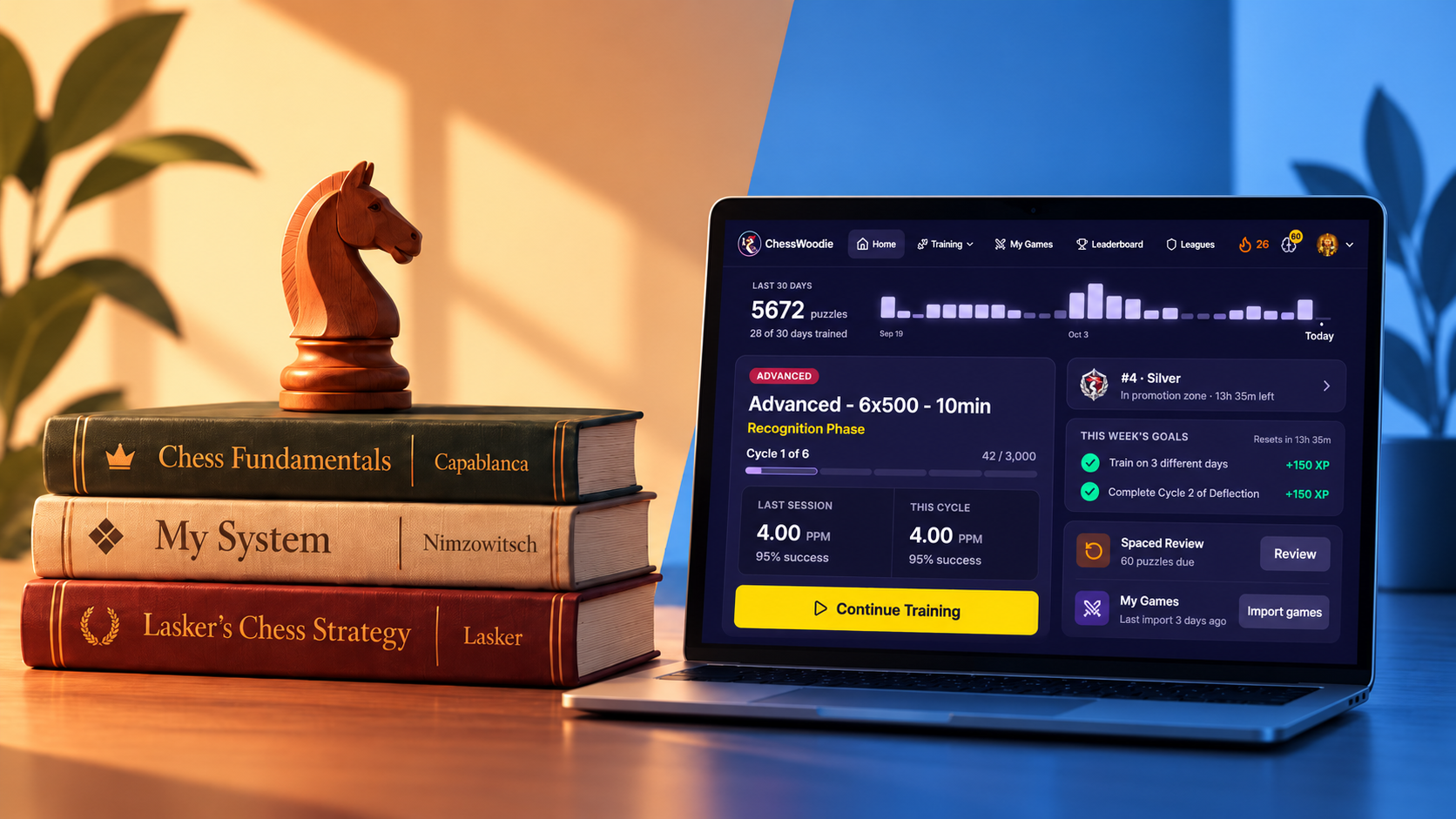
This is also the idea that originally inspired me to build ChessWoodie: automating the organization of repetitive tactical training so the player can focus on solving the positions. Our guide to practicing the Woodpecker Method online explores this in more detail.
Neither approach changes the underlying training principle. What changes is how much work the player needs to do outside the exercises themselves.
Ultimately, chess study doesn't have to be a choice between books and computers.
You might prefer reading a strategy book on a physical board, using a game database to explore related positions, and practicing tactical patterns through an online trainer.
Or you might do everything digitally while deliberately maintaining the habits that make traditional study effective: independent calculation, focused attention, and taking time to understand the positions before checking the answers.
There's no reason to make the learning process unnecessarily inconvenient. But removing every obstacle isn't always the same as improving it.
Final Thoughts
Faustino Oro's experience shows just how far chess education has evolved. A player can now reach the highest levels of the game without relying on books, but that doesn't make traditional study obsolete.
Computers have expanded our access to chess knowledge and made training more efficient than ever before. The challenge is ensuring that convenience doesn't replace the independent thinking required to improve.
The goal isn't to spend as little time as possible on each position, nor to make studying unnecessarily difficult. It's to spend our mental effort where it actually matters.