How to Break Through a Chess Improvement Plateau
You've been playing regularly. You're doing puzzles. Your rating hasn't moved in months.
This happens to almost every chess player at some point. And it's rarely about effort. Most players who hit a chess improvement plateau are already putting in time. The problem is what they're doing with it.
Is It Actually a Plateau?
Chess ratings are noisy. A bad week, a rough stretch of opponents, a few games where you just weren't focused. None of that is a plateau.
A real plateau is when you've put in consistent effort over two or three months and your rating hasn't moved in either direction. If that's you, the problem isn't effort. It's what you're doing with it.
Why Chess Players Get Stuck at the Same Rating
The most common cause isn't laziness. It's a broken feedback loop.
You play a game, lose, and open the next one. The mistake that cost you goes unexamined. Maybe it's a tactical pattern you keep missing. Maybe it's a type of position you handle badly every time. You never look back, so the pattern gets reinforced instead of corrected. Multiply that across fifty games a month and you haven't had fifty learning opportunities. You've practiced the same mistake fifty times.
A Stanford study on 96,000 Chess.com players found that people who mixed playing with review and puzzle training improved significantly faster than those who only played. The players grinding games alone weren't plateauing from lack of effort. They were plateauing because effort without feedback doesn't produce learning.
One thing worth addressing: you'll often hear that the solution is to stop playing blitz. That advice comes almost entirely from coaches working with OTB tournament players. In that context, blitz competes with deep analytical practice for the same limited hours. For players focused on online rapid or blitz, the evidence doesn't really support that. The problem isn't blitz. It's playing any format without reviewing what went wrong. Fifty blitz games with review will teach you more than fifty rapid games without it.
How to Diagnose Why You're Stuck
Most plateaued players share the same ritual after a loss: close the tab, open the next game. That's the loop that keeps you stuck.
There are two kinds of review worth doing, and they serve different purposes. Bulk analysis tools like Lichess Tutor and Aimchess look across many games at once and surface recurring patterns. Lichess Tutor breaks down your performance by phase, tactical awareness, and clock usage, benchmarked against players at your rating. Aimchess works with both Chess.com and Lichess and flags things like which openings are hurting you by color, how often you collapse from winning positions, and whether your play deteriorates under time pressure. These tools are good for getting a high-level picture of where your games are going wrong.
Individual game review is different. Going through a game yourself, even briefly, helps you understand why a mistake happened, not just that it happened. That understanding is what makes the pattern stick. Bulk tools once a month, individual review regularly.
One important caveat: what these tools surface is not always what you should prioritize. A lot of players will see openings flagged as a weak area and go spend hours on theory. But below 1800, most games are decided by blunders and missed tactics, not opening preparation. Your opponents at that level don't know theory deeply either. If your games are full of tactical mistakes, fixing that will move your rating far more than learning the Ruy Lopez. Openings matter eventually, but they're not the lever at this stage. When Should You Start Learning Chess Openings? covers what's worth studying now and what can wait.
For most players under 1800, the diagnosis points to the same thing: tactics. Not sophisticated combinations, just missed threats and patterns they've seen before but didn't recognize fast enough when it mattered.
Why Solving New Puzzles Every Day Doesn't Fix a Plateau
If you're already doing tactics puzzles and still stuck, the problem is probably how you're training, not whether you're training.
Solving a fresh set of puzzles every session feels productive. But it's closer to testing yourself than training yourself. You see a position once, work it out or fail it, and move on. That builds exposure to patterns, but exposure isn't the same as recognition.
Why Solving New Chess Puzzles Every Day Doesn't Improve Your Tactics
The difference shows up in your games. A pattern you've seen once requires calculation when it appears on the board. A pattern you've seen a hundred times is just there. You see the position and the move surfaces automatically. The first kind of knowledge helps when you have time to think. The second kind helps everywhere: under time pressure, when you're tired, when you're nervous. Most improving players are building the first kind and wondering why it isn't showing up in their games.
The Fix: Train for Recognition, Not Exposure
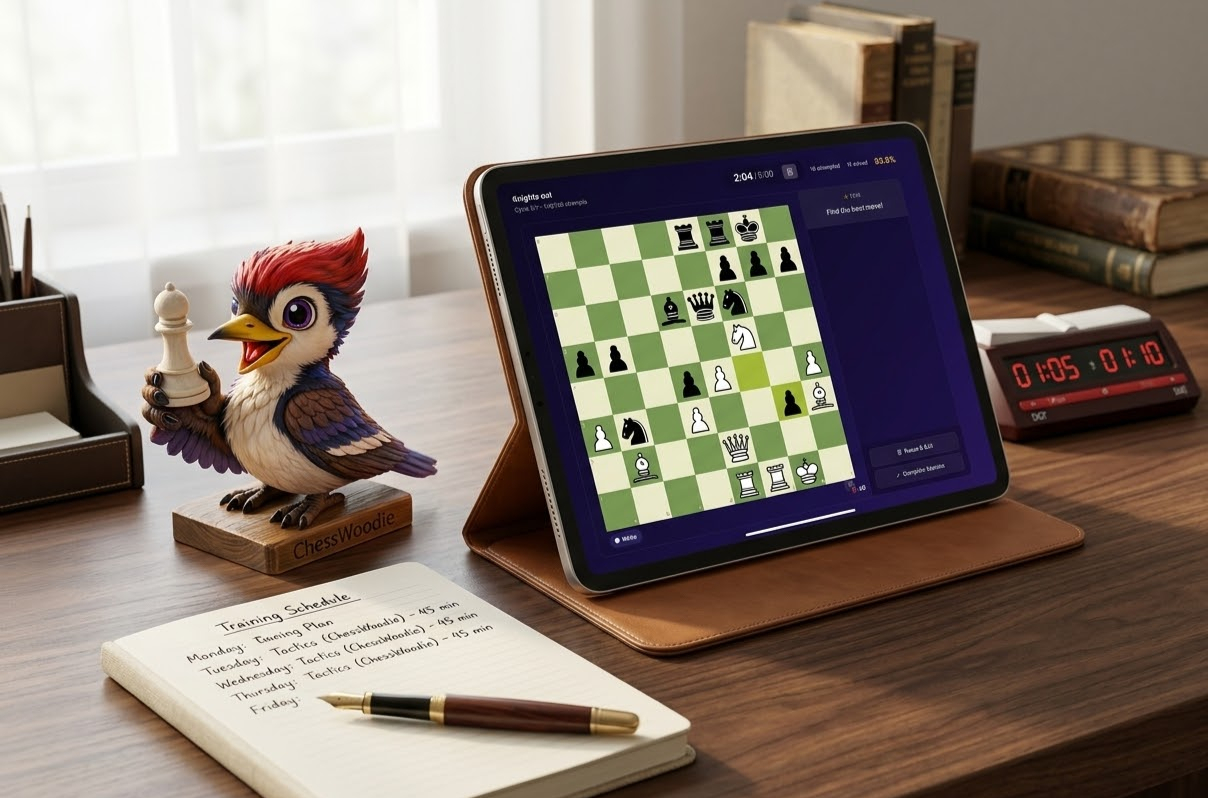
This is where the Woodpecker Method comes in. And it's the core of what actually breaks a plateau.
Instead of solving new puzzles every day, you work through a fixed set of tactical positions. Then you solve the same set again, faster. Then again. Each cycle, the positions get more familiar and recognition becomes more automatic. The goal is to move patterns from something you calculate into something you just see.
The method was developed by GMs Axel Smith and Hans Tikkanen. The most cited results come from OTB classical chess. Tikkanen achieved three GM norms in seven weeks using this approach. But the mechanism works regardless of what format you play. In blitz or rapid, automatic pattern recognition is more valuable than in classical, not less. If you have to calculate a pattern you've already seen before, you're spending time you might not have.
It asks something counterintuitive: solve fewer puzzles, not more. Go deep on a fixed set rather than wide across thousands. Most players resist this because it feels like going backward. It isn't. It's the actual mechanism by which patterns get encoded.
What to Do When You're Stuck at a Chess Rating
Here's the concrete plan:
1. Run the diagnostic. Open your last 30 games in your platform's review tool. Don't go move by move. Look for the category of mistake costing you the most games. For most players under 1800, it's tactics.
2. Stop solving new puzzles every day. If your current approach is a fresh set of positions each session, pause it. You're training volume. You need to train depth.
3. Switch to repetition-based training. Work through a fixed set of positions, then solve the same set again, faster. Track what you get wrong and focus the next cycle on those. The positions you keep missing are exactly the patterns your brain hasn't encoded yet.
4. Keep playing, but review. Don't stop playing games. After each session, spend a few minutes with the review tool. You're checking whether the same errors are still appearing. As your pattern recognition improves, the character of your losses should start to shift.
For structuring the balance between playing and study time, A Daily Chess Training Plan for Busy Players has a practical framework. How to Train Chess Tactics Effectively goes deeper on why repetition beats breadth.
The Honest Part
Even with the right approach, improvement is slow. Plateaus often last months. The research on chess skill development shows that gains follow a curve that flattens the higher you go. You're not doing it wrong just because progress feels incremental.
What you can control is whether your effort is actually going somewhere. Playing more games without review is effort with no return. Chasing new puzzles instead of drilling depth is effort with no transfer. Fix those two things and improvement becomes a question of when, not if.