A Daily Chess Training Plan for Busy Players
Most chess training advice assumes you have two to four hours a day. You probably have much less than that.
This article gives you a daily chess training plan that works within those constraints. Not by cutting corners, but by being clear about what to prioritize and in what order.
Why Most Training Plans Fail
The two most common reasons: the plan is too ambitious, or it has no hierarchy.
A 90-minute daily plan fails by Wednesday. When life interrupts, there is no fallback and the habit breaks. GM Sergey Shipov puts it plainly: the important question is not how long you study, but how and what. A plan you can actually follow beats a perfect plan you abandon in week two.
The other failure is treating openings, tactics, endgames, and game review as equally important every day. Each area gets too little time to matter, and when you are short on time you do not know what to cut.
GM Noel Studer draws a useful distinction: the goal is not an easy plan but a simple one. Simple means you always know what to do next. Easy means it requires no effort. They are not the same.
There is also a quieter failure: studying something too shallow to be useful. This applies especially to openings. Half-knowing a line is not neutral, it is a liability. You reach a position you recognize but cannot navigate, your opponent plays a sideline at move 8, and you are on your own. You would have been better off knowing nothing about that opening and relying on general principles.
Who This Plan Is For
Players roughly between 1000 and 1800 Elo (online rapid). This is the range where the evidence is clearest.
Data from over 1 million games shows that over 70% of games in the 1000-1800 range end before reaching complex endgames. According to The Woodpecker Method by GMs Axel Smith and Hans Tikkanen, 72% of games between 1800-2000 FIDE players are decided by tactical mistakes. Below 1800, that number is higher.
GM Avetik Grigoryan of ChessMood states this plainly: at the 1000-1500 level, 90% of the time the middlegame is won by the player with better tactical skills. A player can most probably cross 1500 on sharper tactics alone.
Above 1800 the balance shifts. Endgames and opening knowledge start to matter more. The structure here still applies, but you should weight the secondary areas more heavily once your tactical foundation is solid.
The Three-Layer Structure
Layer one: tactics, every day. The length of each session will vary, but the session itself does not get skipped. It is the foundation everything else rests on.
Layer two: play games and review them regularly. Most players will play naturally - that is fine and expected. What matters is that at least some of what you play is at a longer time control, and that you review those games. A few game reviews per week is realistic for anyone playing regularly. Without this layer, patterns built in puzzle sessions often fail to transfer to actual games.
Layer three: one area studied deeply, until it is learned. Openings, endgames, or a positional theme - one at a time. You do not switch until the work is genuinely done.
Any effective daily chess training routine needs to answer one question clearly: when time runs short, what stays and what goes? This structure does that.
The third layer is where most advice goes wrong. A weekly rotation - openings Monday, endgames Thursday - produces shallow, fragmented knowledge. GM Studer is explicit: pick one focus, stick with it until you decide it is time to change, and do not add things alongside it.
For openings especially, this matters. An opening is not moves to memorize. It is positions to understand. Plans for both sides, typical structures, common tactical patterns. One session per week alongside three other rotating topics will not build that understanding.
Layer One: Daily Chess Tactics Training
GM Alex Colovic describes daily chess tactics training as mental hygiene: just like brushing your teeth, you do it every day whether you feel like it or not. The goal is pattern recognition -- seeing tactical shapes automatically, without consciously searching for them.
Repetition is what builds this. Random puzzle feeds help a little. Solving the same positions multiple times, getting faster each cycle, is what actually ingrains patterns. That is the logic behind the Woodpecker Method: solve a set, solve it again faster, then again. Each cycle deepens the pattern. For a complete guide to structuring your tactics training around this principle, see How to Train Chess Tactics Effectively.
15-minute session (minimum viable day)
- 5 min: warm-up with a few easy puzzles to activate your tactical thinking
- 10 min: focused work through your current training set, from where you left off
30-minute session (standard day)
- 5 min: warm-up
- 20 min: main block at your target difficulty
- 5 min: review puzzles you got wrong. Set them up again and find the idea from scratch
60-minute session (full day)
- 5 min: warm-up
- 25 min: main block
- 10 min: deeper mistake review across the past few sessions
- 20 min: Layer Three work
Layer Two: Weekly Game and Review
Play as much as you want - chess is meant to be played. But make sure at least one game per week is at a longer time control: 10+5 minimum, 15+10 or longer if possible. Blitz will not do for training purposes. Longer games are where you practice calculation and planning under genuine pressure, with actual consequences for careless moves.
The other part of this layer is reviewing what you play. Not every game needs a deep post-mortem, but a few reviews per week will compound quickly. For a step-by-step approach to getting the most out of game analysis, see How to Analyze and Review Your Chess Games.
Start without an engine: where did you feel uncertain, where did the game turn? Then check with the engine. The goal is not to find every inaccuracy. It is to understand the one or two moments that decided the game.
GM Studer's approach is to classify what went wrong: opening, tactics, strategy, or endgame. Over several weeks this reveals a pattern that tells you what to focus on in Layer Three. Your games are not just practice - they are diagnostic data.
Layer Three: One Area, Until It Is Done
Pick one area and stay with it until the work is finished. Then move on.
What "done" looks like:
For an opening, you understand the main ideas in every line you are likely to face, you can play the first 10-12 moves confidently, and you have tested it in real games and reviewed them. You are no longer getting surprised.
For endgames, you can solve a defined set of positions reliably, and you understand the principles, not just the answers.
For a positional theme, you can recognize the relevant structure in your games and have a clear plan for it.
What to focus on first:
Your game reviews will tell you. If you keep losing to the same problem - opening confusion, missed tactics, lost endgames - that is your area.
If you have no data yet, start with endgames. Basic endgame knowledge transfers directly to how you play the middlegame, and unlike opening theory, it does not go stale.
A note on openings: Most coaches recommend spending no more than 20% of total training time on openings below 1800. Below that level your opponent does not know the theory well either. Understanding the ideas matters more than memorizing lines. When your Layer Three focus is openings, the work is: understand the philosophy, learn the typical structures, know the plans for both sides. Not: memorize variations to move 20.
Sample Daily Chess Training Routines
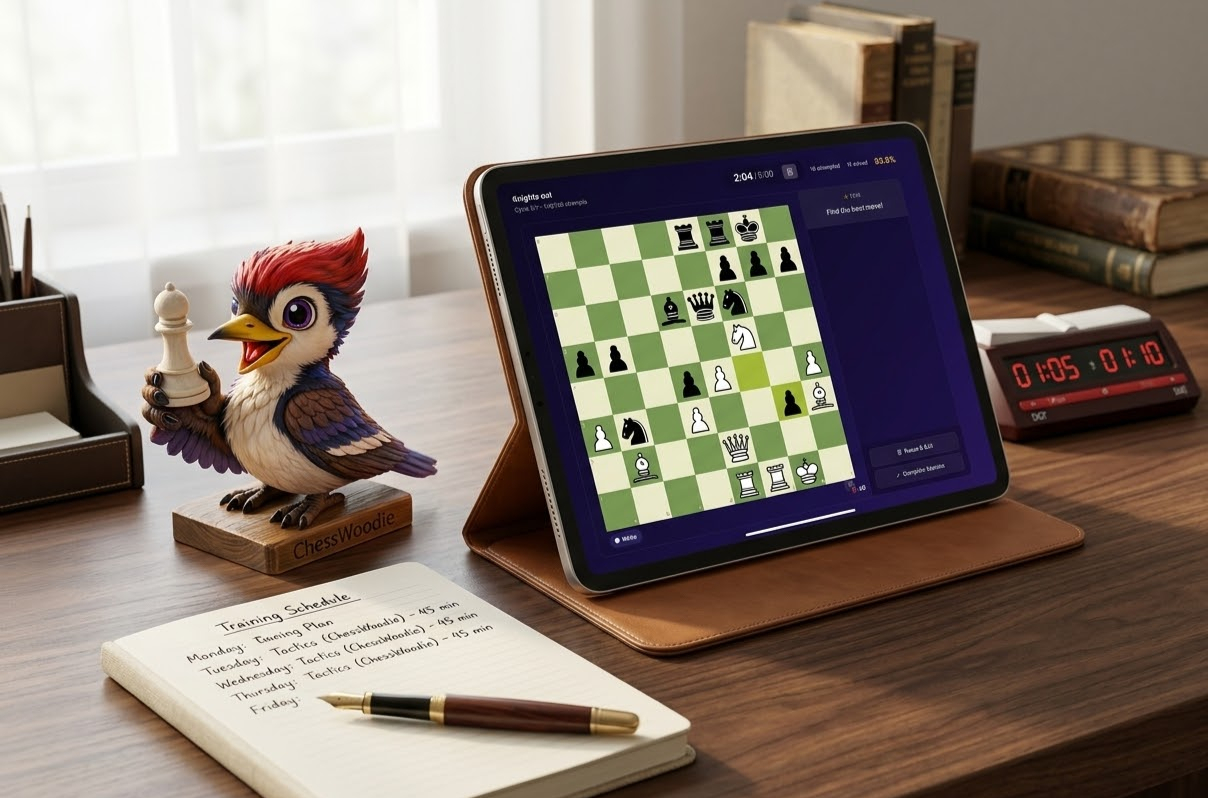
The schedules below show the tactics and Layer Three structure. Games are not shown because you will play whenever you can. Just make sure at least one per week is at a real time control and gets reviewed.
Compact week (3.5 hours)
| Day | Session | Time |
|---|---|---|
| Monday | Tactics standard | 30 min |
| Tuesday | Tactics minimum | 15 min |
| Wednesday | Tactics standard | 30 min |
| Thursday | Tactics minimum | 15 min |
| Friday | Tactics standard | 30 min |
| Saturday | Tactics + game review | 75 min |
| Sunday | Off | -- |
Standard week (5.5 hours)
| Day | Session | Time |
|---|---|---|
| Monday | Tactics standard | 30 min |
| Tuesday | Tactics + Layer Three | 55 min |
| Wednesday | Tactics standard | 30 min |
| Thursday | Tactics standard | 30 min |
| Friday | Tactics + Layer Three | 55 min |
| Saturday | Tactics + game review | 75 min |
| Sunday | Off | -- |
Minimal week (under 2 hours)
Some weeks fall apart. The goal is to keep the habit alive.
| Day | Session | Time |
|---|---|---|
| Monday | Tactics minimum | 15 min |
| Wednesday | Tactics minimum | 15 min |
| Friday | Tactics minimum | 15 min |
| Saturday | Tactics + game review | 50 min |
How Long to Train Chess: Decision Rules
How long should you train chess each day? The honest answer is: as long as you can do consistently. A 15-minute session you actually show up for beats a 90-minute session you keep postponing. Here is how to decide based on what your day allows.
Only 15 minutes? Tactics only. Compressed opening or endgame work does very little.
Missed a day? Resume normally. Do not double up.
Unexpected free hour? Add a Layer Three session, or play a game if you have not this week.
Tournament coming up? Keep daily tactics. Use the Layer Three slot for opening prep against expected opponents. Review your recent games more carefully than usual.
Is It Working?
Rating in the short term tells you very little. Better signals:
Familiar patterns in tactics sessions are coming faster. Game reviews show fewer of the same mistakes repeating. You are reaching the middlegame with a plan rather than guessing. You are spending less clock time on decisions that should be automatic.
For a more systematic approach to tracking progress, see How to Measure Chess Tactics Training and Improvement.
Tactics every day because that is where games at this level are decided, and because repetition compounds in a way that occasional study does not.
One serious game per week because applying knowledge under pressure is what converts study into skill.
One focused area at a time because shallow knowledge of many things is worse than solid knowledge of one.
The hard part is not understanding the plan. It is showing up for the 15-minute tactics practice session on a Tuesday night when you are tired. That session, repeated week after week, is what moves your chess forward - even for the busiest players.
Want to understand why repetition beats variety for pattern recognition? Read How to Train Chess Tactics Effectively. For the full methodology behind repetition cycles, see The Woodpecker Method Online. For more on connecting training to results, see How to Improve at Chess.