The Woodpecker Method Online: How to Train Chess Tactics Properly
The Woodpecker Method, introduced by Axel Smith and Hans Tikkanen in the book The Woodpecker Method, is widely considered one of the most effective ways to train chess tactics and build long-term pattern recognition.
It is especially powerful for players who want a systematic way to train tactics online, without relying on random puzzles or guesswork.
At its core, the method is built around a simple idea:
repeat the same tactical positions over multiple cycles until recognition becomes automatic.
Players who follow the method correctly often experience faster decisions, more confidence in familiar patterns, and better transfer of tactics into real games.
More Than Tactics: Why the Woodpecker Method Builds Real Training Discipline
One often underestimated benefit of the Woodpecker Method is that it naturally pushes players toward systematic, daily chess training.
Because the method is structured and finite:
- sessions feel intentional rather than endless
- progress is visible across repetitions
- training becomes a habit, not an occasional activity
Many players improve not only because of repetition, but because they finally commit to showing up every day.
How the Woodpecker Method Works
The structure of the method is straightforward:
- A fixed set of tactical puzzles is selected
- The same set is solved repeatedly over several cycles
- Early cycles are slow and calculation-heavy
- Later cycles become faster as patterns are recognized instantly
The goal is not to calculate deeper every time.
The goal is to recognize tactical motifs immediately.
Over time, this creates a mental library of patterns that can be recalled quickly during games.
Why the Woodpecker Method Is Effective (When Done Correctly)
The Woodpecker Method works because repetition changes how the brain processes information.
Repeating the same chess puzzles:
- strengthens memory
- reduces hesitation
- shifts thinking from calculation to recognition
This is why speed increases naturally across cycles and why familiar positions start to feel obvious.
When done correctly, woodpecker chess training improves both accuracy and confidence.
Why the Woodpecker Method Is Hard to Practice Offline
While the method itself is simple, practicing it offline can be surprisingly demanding.
Training with a book, a board, and a notebook usually means:
- setting up the board for every puzzle
- writing down solutions and mistakes
- tracking success rates manually
- keeping track of cycles by hand
- timing sessions and calculating throughput yourself
None of this improves your tactics.
It just adds friction.
Over time, this bookkeeping competes with actual training. Sessions take longer, consistency drops, and many players stop altogether.
Can You Practice the Woodpecker Method Online?
Yes, you can practice the Woodpecker Method online.
But only if the online setup respects the method instead of working against it.
Most generic chess puzzle platforms are designed for variety and novelty. The Woodpecker Method requires the opposite: repetition, structure, and consistency. This is also why solving new chess puzzles every day often feels productive but rarely leads to lasting improvement.
Proper Woodpecker Method online practice must support:
- repeating the same puzzle set
- clear cycle boundaries
- speed-aware training
- progress tracking without manual effort
Without these, online training becomes just another version of random puzzle solving.
What Proper Woodpecker Method Online Practice Requires
To practice the Woodpecker Method online properly, several things are non-negotiable.
Fixed Puzzle Sets
You must train on the same puzzles across cycles. No reshuffling. No dilution.
Automatic Cycle Management
You should never wonder which cycle you are in or whether a repetition is finished.
Built-in Tracking
Success rate, speed, and overall throughput should be tracked automatically. You should not be calculating anything yourself.
Focused Training Sessions
During a session, the only task should be solving puzzles. No forced analysis. No distractions.
This is what makes repeating chess puzzles effective rather than exhausting.
Why a Purpose-Built Tool Matters
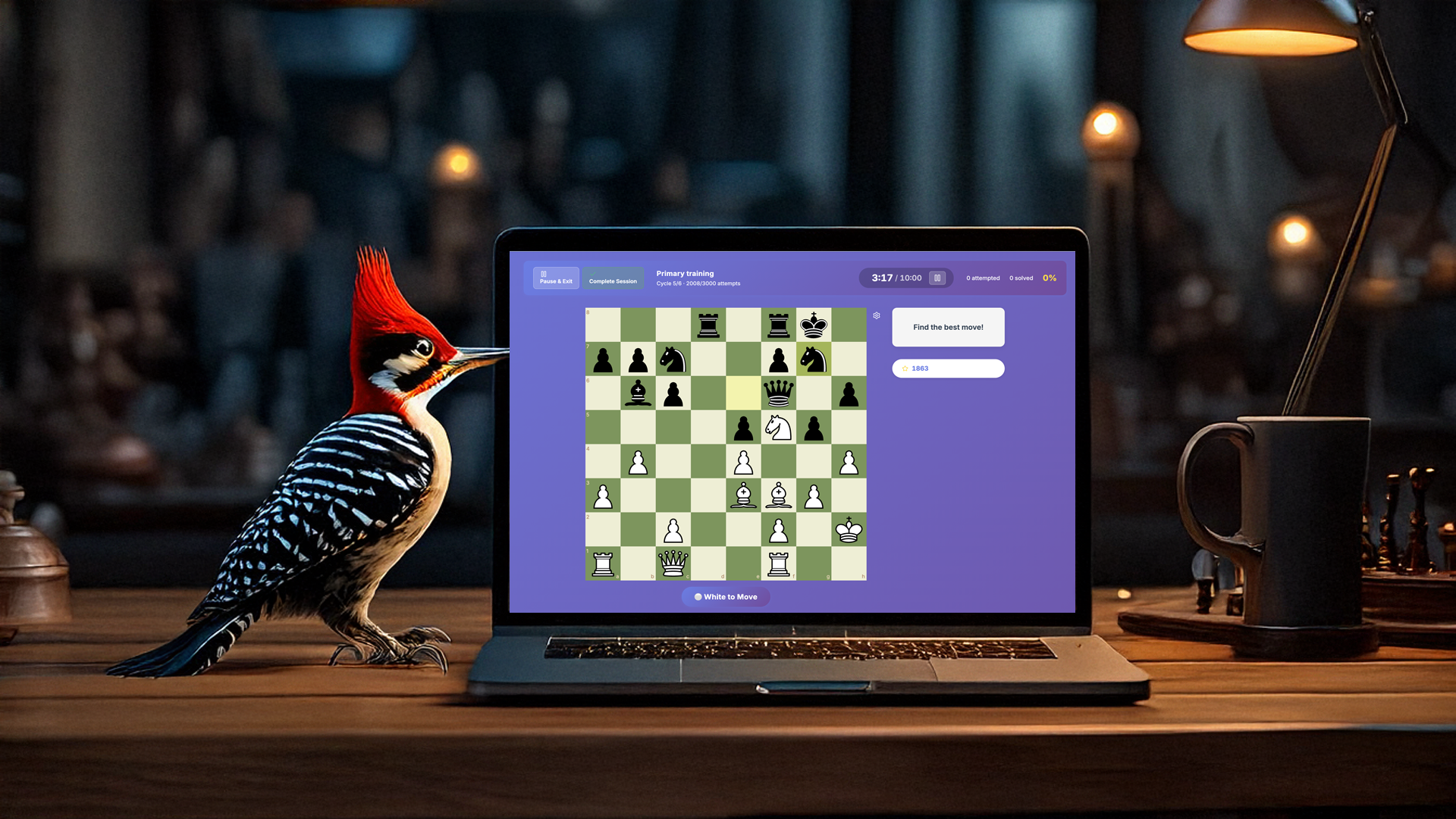
This is where a dedicated Woodpecker Method online tool makes a real difference.
A platform like ChessWoodie is designed specifically around:
- repetition-based chess tactics training
- automatic cycle handling
- speed and accuracy tracking
- minimal cognitive overhead
Board setup, bookkeeping, and progress tracking disappear into the background.
Instead of managing the method, you just train. If you want to try this approach yourself, you can log in and start a Woodpecker-style training session online.
How to Tell If Your Online Woodpecker Training Is Working
Regardless of the tool you use, effective Woodpecker practice shows clear signs:
- familiar positions feel instantly solvable
- time per puzzle drops across cycles
- hesitation decreases
- tactics appear more naturally in games
If none of this is happening, the issue is usually structure, not effort.
Final Thoughts
The Woodpecker Method is one of the most reliable ways to improve tactical pattern recognition. But it is not forgiving of friction.
Practicing it offline creates unnecessary overhead. Practicing it on the wrong platform weakens the method.
Practicing the Woodpecker Method online works best when repetition, cycles, and tracking are handled for you, so all your attention goes into recognizing patterns.
When that happens, daily training becomes sustainable. And improvement follows.